
Tan Delta testing (dissipation factor or loss angle measurement) is the leading diagnostic method for assessing the global condition of medium voltage cable insulation. While a withstand test proves a cable can survive a voltage stress, Tan Delta answers a deeper question: how healthy is the insulation, and how fast is it aging? Performed per IEEE 400.2-2024, Tan Delta measurement allows utilities and industrial plants to rank cable circuits by condition, plan replacements based on data, and avoid both premature replacement and unexpected failures.

What Tan Delta measures
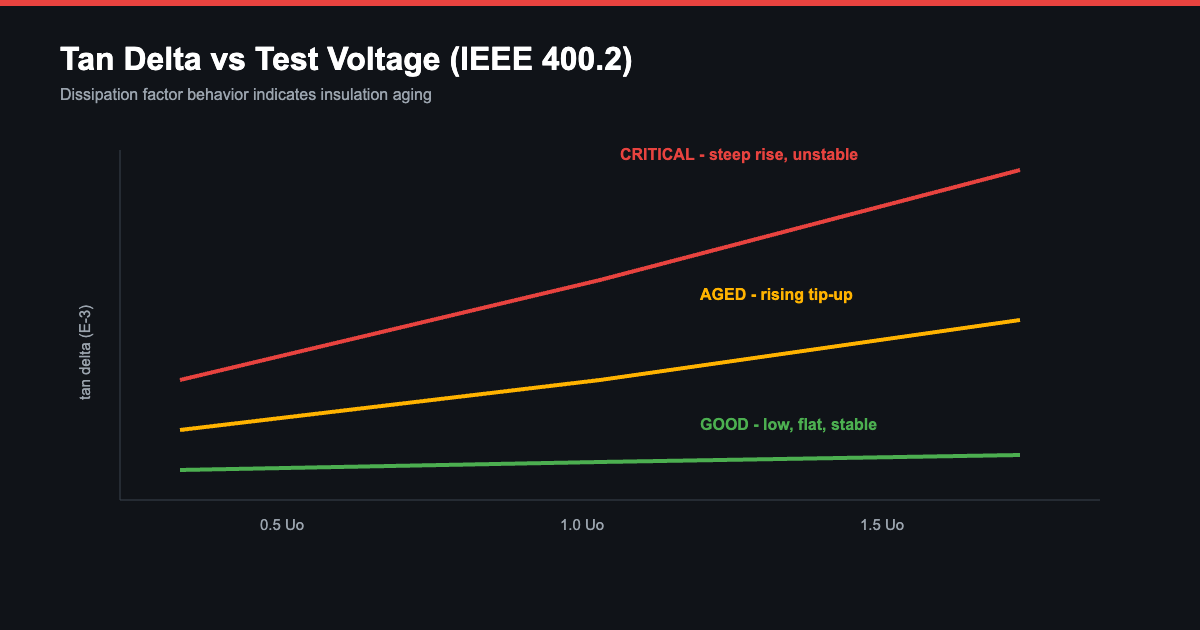
A perfect insulation behaves as a pure capacitor: current leads voltage by exactly 90 degrees. Real, aged insulation has resistive losses – caused mainly by water trees in extruded cables – that shift this angle. The tangent of the loss angle (tan delta) quantifies these losses. A new XLPE cable shows very low values; as water treeing progresses, tan delta rises, and its behavior with voltage becomes unstable. Three indicators are evaluated per IEEE 400.2: the absolute tan delta value, the tip-up (difference between values at different voltage steps) and the standard deviation over time at each step.
How the test is performed
The cable is de-energized, isolated and grounded. Using a VLF source with integrated tan delta measurement, voltage is applied in steps – typically 0.5, 1.0 and 1.5 times rated phase-to-ground voltage – and the dissipation factor is measured at each step over several cycles. The full measurement takes only minutes per phase, making Tan Delta the most cost-effective screening diagnostic available for MV cable fleets.
Interpretation and condition ranking
IEEE 400.2-2024 provides assessment criteria for service-aged XLPE, EPR and PILC cables. Based on the measured figures, each circuit is classified: No action required – insulation in good condition; Further study advised – degradation present, retest at reduced interval or complement with partial discharge testing; Action required – advanced degradation, plan repair or replacement. This classification converts raw measurements into an actionable asset management decision – the foundation of condition-based maintenance for cable systems.
Residual life analysis
Beyond the standard IEEE assessment, Tecnvolt applies the Statex methodology for residual life estimation of MV cables, combining tan delta trends, cable age, loading history and failure statistics into a projected remaining life per circuit. This data-driven ranking lets asset owners schedule capital replacement programs years in advance instead of reacting to failures.
Tan Delta versus other diagnostics
Tan Delta is a global diagnostic: it evaluates the average condition of the whole insulation length but does not locate discrete defects. Partial discharge testing is the complementary local diagnostic that pinpoints defective joints and terminations. Best practice per IEEE 400.2 is the Monitored Withstand Test: VLF withstand voltage with simultaneous Tan Delta (and optionally PD) monitoring – one outage window, three layers of information.
What you receive
A complete diagnostic report per circuit: tan delta values per phase and per voltage step, tip-up and stability analysis, classification against IEEE 400.2 criteria, trend comparison with previous campaigns where available, residual life estimate, and prioritized recommendations. The report is designed to plug directly into maintenance planning and capital budgeting.
Why Tecnvolt
Since 2012, Tecnvolt Engenharia has built one of the most experienced MV cable diagnostics practices in Brazil, using BAUR VLF and Tan Delta platforms – the same equipment used by U.S. testing firms – for clients in oil and gas, ports, data-intensive industry and utilities. ISO 9001, 14001 and 45001 certified.
Frequently asked questions
Does Tan Delta testing stress the cable? Minimally. Measurements start below operating voltage, and the stepped profile follows IEEE 400.2 guidance precisely to avoid overstressing aged insulation.
How often should circuits be tested? Healthy circuits: every 3 to 5 years. Circuits classified as Further Study: 1 to 2 years. Critical feeders and aged fleets benefit from annual trending.
Can one campaign cover withstand and diagnostics? Yes – the Monitored Withstand Test combines VLF withstand, Tan Delta and optionally PD in a single mobilization and outage window.
About our U.S. transition
Tecnvolt Engenharia is a Brazilian company founded in 2012, currently in the process of establishing a U.S. company in Houston, Texas. During this transition we are receiving inquiries and scheduling future work. Request a quote / register interest