
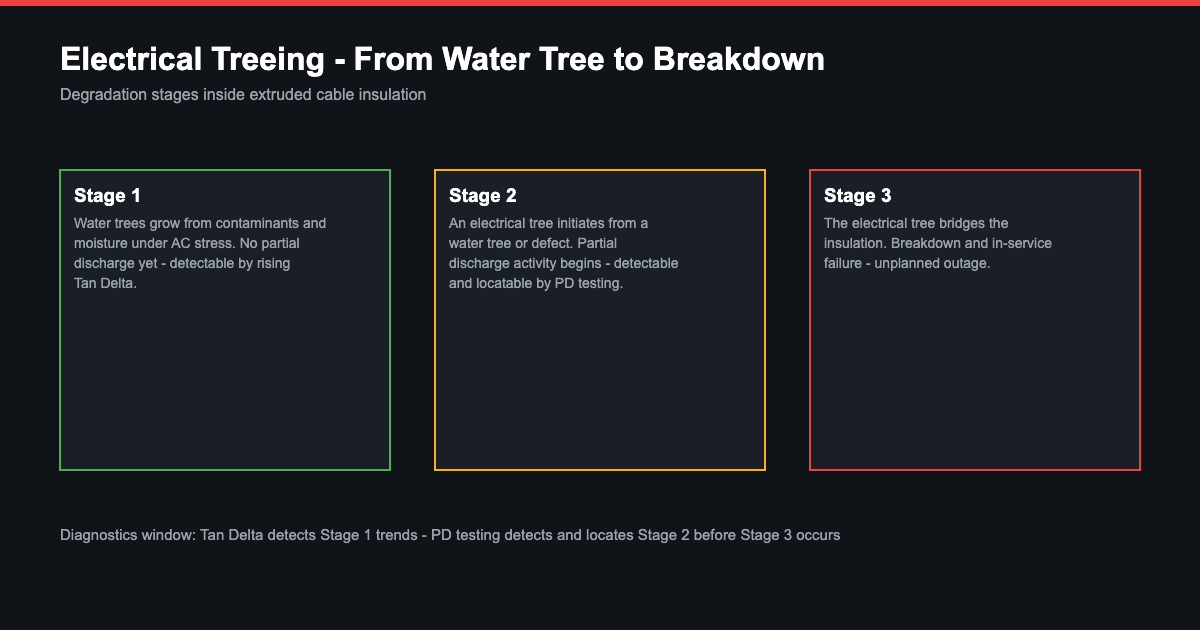
Partial discharge testing is the most sensitive diagnostic available for locating discrete defects in medium voltage cable systems – defective joints, poorly installed terminations, voids, contamination and mechanical damage. A partial discharge (PD) is a small electrical spark that bridges only part of the insulation under voltage stress. Each discharge erodes the insulation a little more, until the defect evolves into a complete breakdown and an unplanned outage. Detecting and locating PD activity before failure is the essence of predictive maintenance for cable networks, per IEEE 400.3 and referenced in IEEE 400.2-2024 and ANSI/NETA MTS.
Why joints and terminations dominate failures
Field statistics across utilities and industry are consistent: the majority of MV cable failures do not occur in the cable itself, but in its accessories – joints and terminations – where workmanship, contamination and interface stresses concentrate. These are exactly the defects that global diagnostics like Tan Delta cannot see, and that PD testing detects and locates with precision of a few meters along the route.
How offline PD testing and mapping works
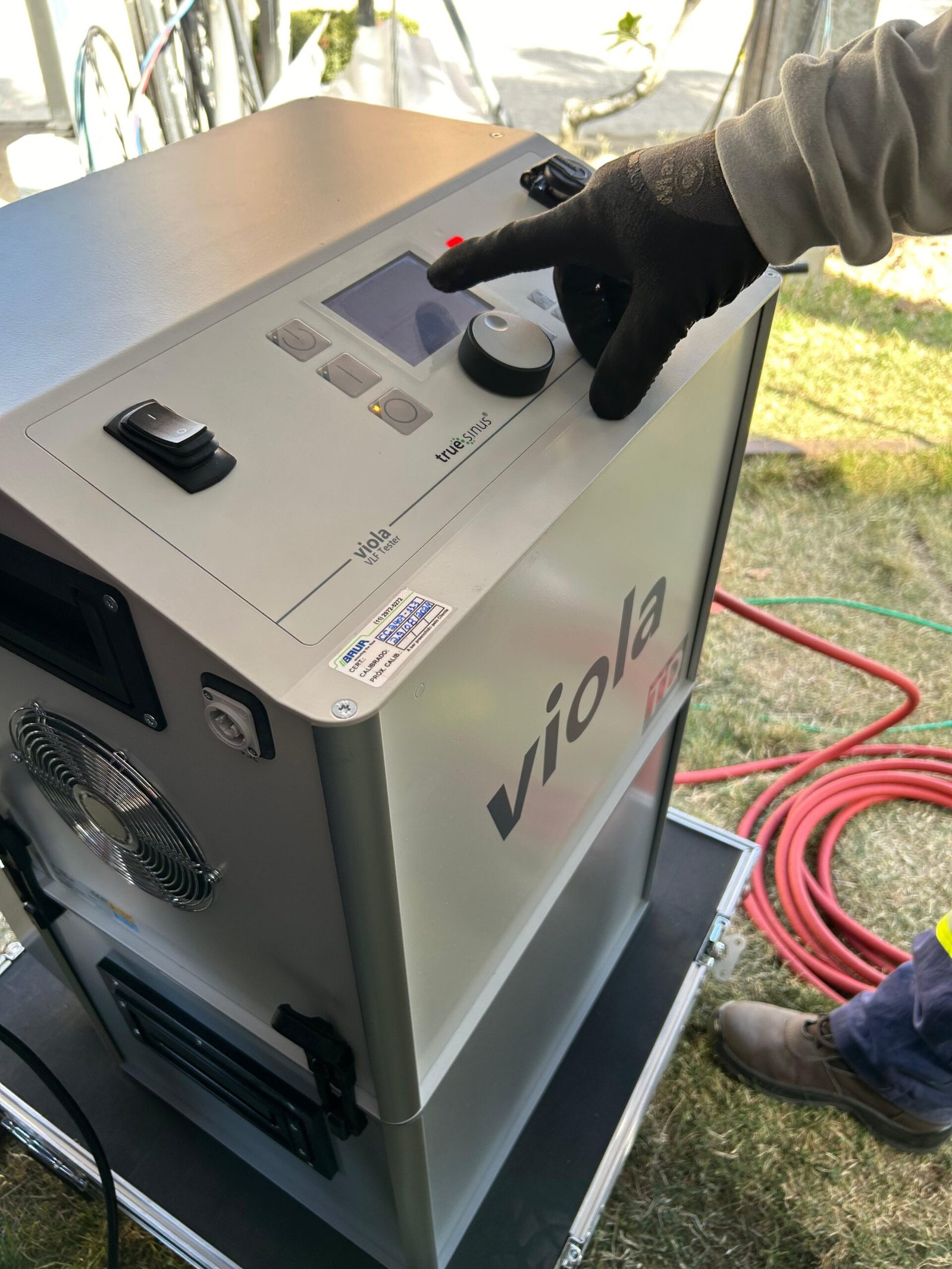
The cable is de-energized and energized from a VLF or damped AC source at controlled voltage levels. PD sensors coupled to the circuit capture the high-frequency pulses generated by discharge activity. By time-domain reflectometry analysis of each pulse and its reflection, the measuring system computes the location of every PD source along the cable length, producing a PD map: discharge magnitude (in picocoulombs), inception and extinction voltages, and position. The result is a defect list with coordinates – directly actionable by maintenance crews.
What the results tell you
Interpretation follows a defect-severity logic: PD inception voltage below or near operating voltage indicates a defect active in normal service – high priority; discharge magnitude and repetition rate indicate how advanced the erosion is; and location tells whether the source is a joint, a termination or a cable section. Combined with Tan Delta results, the asset owner gets both the global aging picture and the discrete defect list for each circuit.
Typical applications
Commissioning acceptance of new cable installations – workmanship defects in new joints and terminations are a leading cause of early failures and are readily detected by PD testing before energization; condition assessment of critical feeders in industrial plants, data centers, hospitals and port facilities; forensic analysis after in-service failures, to verify whether sister circuits share the same defect pattern; and periodic predictive maintenance of aged cable fleets.
Standards and equipment
Testing follows IEEE 400.3 (Partial Discharge Testing of Shielded Power Cable Systems in the Field), integrated with IEEE 400.2 monitored withstand practice and ANSI/NETA MTS tables. Tecnvolt uses PD measurement integrated with BAUR VLF platforms, with calibrated charge injection for magnitude verification.
What you receive
A PD assessment report per circuit: PD map with defect locations, magnitudes and inception/extinction voltages per phase; severity classification and prioritized repair list; correlation with Tan Delta and withstand results when performed together; and recommendations with retest intervals. Reports are engineering-grade and audit-ready.
Why Tecnvolt
Tecnvolt Engenharia has delivered cable diagnostics since 2012 for oil and gas, industrial, port and utility clients, integrating VLF withstand, Tan Delta and PD in single-mobilization campaigns per IEEE 400.2. ISO 9001, ISO 14001 and ISO 45001 certified.
Frequently asked questions
Can PD testing find defects in brand new cables? Yes – poor workmanship in new joints and terminations produces detectable PD long before failure, which is why PD is increasingly specified in acceptance testing.
Is the cable damaged by the test? No. Test voltages follow IEEE guidance, and measurement time at each level is short. The information gained far outweighs the brief controlled stress.
What accuracy does PD mapping achieve? Typically within a few meters along the route – enough to identify which joint or termination requires intervention.
About our U.S. transition
Tecnvolt Engenharia is a Brazilian company founded in 2012, currently in the process of establishing a U.S. company in Houston, Texas. During this transition we are receiving inquiries and scheduling future work. Request a quote / register interest