
Infrared thermography is the fastest, least intrusive predictive inspection for electrical systems: it sees heat where current meets resistance. Loose connections, overloaded conductors, unbalanced phases, failing breakers and degraded splices all announce themselves as thermal anomalies long before they burn open or start a fire. Performed with the installation in service and under load, a thermographic survey per ANSI/NETA MTS guidance covers an entire facility with zero downtime.
What thermography finds
Typical findings, ordered by frequency in industrial surveys: loose or corroded bolted connections in panels, bus and switchgear; overloaded circuits and unbalanced phases; failing fuse clips and breaker contacts; degraded cable terminations; blocked ventilation and failing cooling on transformers; and motor and MCC anomalies. Each is invisible to the eye and obvious to the camera – a temperature rise classification directly drives the repair priority.
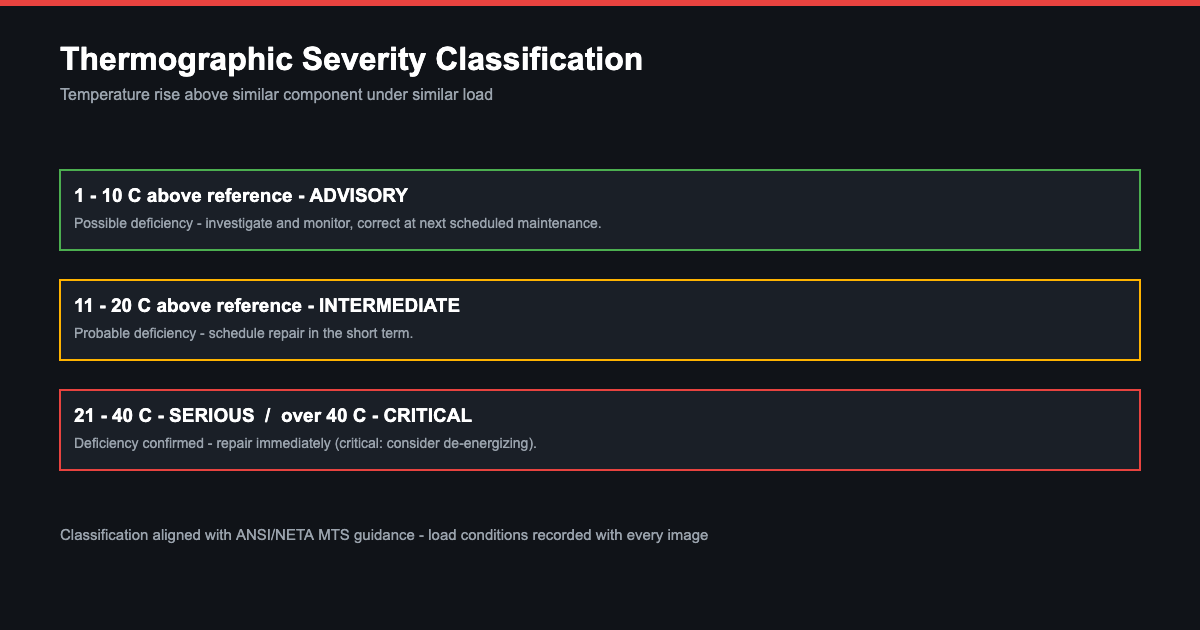
Severity classification
Findings are classified by temperature rise above reference (similar component under similar load), following ANSI/NETA MTS guidance: minor deviations flagged for next scheduled maintenance; intermediate anomalies scheduled for short-term repair; and critical differentials requiring immediate action. Load conditions are recorded with every image – a connection at 30 percent load hides problems that appear at 80 percent, so survey timing matters and is planned with operations.
Survey scope
A complete electrical thermography program covers: MV and LV switchgear and panels (with appropriate safety procedures and, where installed, IR windows); transformers, bushings and cooling systems; motor control centers and critical motors; busways and cable trays; battery systems; and outdoor substation connections. For solar plants, thermography of modules and combiner boxes locates hot spots, failed strings and connection defects across large arrays – see our solar commissioning services.
Safety and method
Electrical thermography is performed by trained personnel under NFPA 70E-aligned safety practices adopted in our ISO 45001 management system: appropriate PPE, panel opening procedures with qualified staff, and camera settings (emissivity, distance, reflected temperature) documented per image so results are reproducible and defensible.
What you receive
A thermographic survey report: every anomaly with thermal and visual image pair, location, measured temperatures and load conditions, severity classification, repair recommendation, and a summary matrix by area and priority – a direct work order source for your maintenance team, and trending data for reliability engineering.
Why Tecnvolt
Thermography has been part of Tecnvolt predictive programs since 2012 – integrated with electrical testing so anomalies are not just photographed but diagnosed. ISO 9001, ISO 14001 and ISO 45001 certified.
Frequently asked questions
Does the plant need to shut down? No – thermography requires equipment energized and ideally above 40 percent load. It is the definitive zero-downtime inspection.
How often should surveys run? Annually for most industrial facilities; semi-annually for critical or heavily loaded systems; and always before insurance renewals and after major load changes.
Can closed panels be inspected? Direct line of sight is required – panels are opened under safe procedures or fitted with IR windows for routine inspection without exposure.
About our U.S. transition
Tecnvolt Engenharia is a Brazilian company founded in 2012, currently in the process of establishing a U.S. company in Houston, Texas. During this transition we are receiving inquiries and scheduling future work. Request a quote / register interest